
Shopping Cart
There are no more items in your cart
Who were the Skjaldmö?
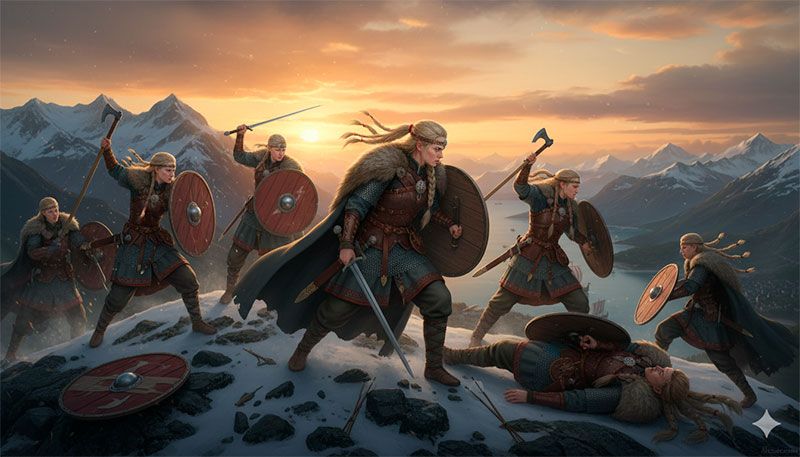
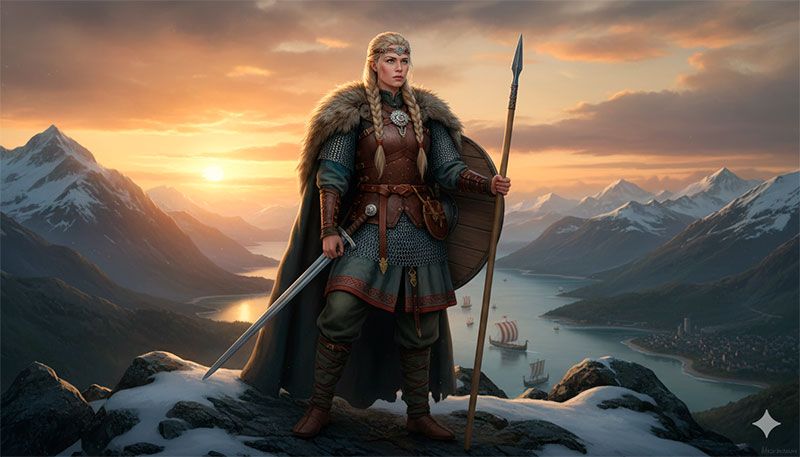
The skjaldmö (from Old Norse skjaldmær, sometimes rendered in English as “shield‑maidens”) are figures that appear in Viking mythology, the sagas and iconography as women warriors. Their depiction mixes history, literature and myth, which requires carefully separating sources and distinguishing the plausible from the symbolic.
Context: the role of women in Norse society
To understand who the skjaldmö were, one must place them in a society where women had notable rights and responsibilities compared with many other parts of medieval Europe. Their most common functions included:
- Administration of the household and farm, especially in the husband’s absence.
- The right to divorce and to inherit property, which granted them economic autonomy.
- Basic practical and martial competencies: handling weapons for defense and local leadership when necessary.
This social reality made it possible for women to hold positions of authority and, on occasions, to take part in armed actions.
What do the literary sources say?
References to skjaldmö appear prominently in:
- The Icelandic sagas and other late Norse texts (mostly composed between the 13th and 14th centuries).
- Chronicles such as Saxo Grammaticus’s Gesta Danorum, which recounts figures like Lagertha.
- Poems and legends where archetypes of women warriors converge with the mythical valkyries.
These accounts offer very concrete characters (Hervor, Lagertha, Skaði) and battle scenes in which women fight alongside men; however, they are texts composed long after the events they narrate and written in Christian and literary contexts, which introduces intentional and stylistic biases.
Lagertha, Hervor and Skaði: myths with historical traits
Lagertha (mentioned by Saxo) is the most famous example —a woman who fights, marries Ragnar Lodbrok and later acts as a leader—. Hervor is a legendary figure who reclaims the family sword Tyrfing and exemplifies the tradition of women warriors in heroic narrative. Skaði, partly a goddess and partly a heroine, appears armed to avenge her father.
Archaeological and iconographic evidence
Archaeology provides evidence that has revived the debate:
- Graves with military burials that, after DNA analysis, have turned out to belong to women (for example, a prominent find at Birka).
- Depictions on objects (brooches, silver pieces, textiles) where female figures appear with sword and shield.
Nevertheless, these pieces of evidence are open to interpretation: the images may represent valkyries —mythical beings— or status symbols. The burial context and funerary rituals also condition the reading.
Academic debate: history or myth?
Contemporary historians propose a nuanced view:
- It is likely that there was no formal institution called “skjaldmö” functioning as a regular female military unit.
- It is plausible that women intervened in conflicts on occasion: defending homes, exercising local leadership, carrying out vendettas or even participating in expeditions.
- Epic narratives exaggerate and turn exceptional episodes into literary archetypes.
The literary emphasis on skjaldmö also often served to convey moral or cultural messages during Christianization: medieval authors could use these characters to contrast active paganism with the more passive Christian ideal of femininity.
What were they like and what roles might they have performed?
According to the mix of sources, skjaldmö could have had varied roles:
- Combat warriors in specific situations (battles, village defense, family vengeance).
- Leaders who exercised authority at the local or clan level (for example: some jarls or women with economic power).
- Symbolism and memory: figures embodying bravery and female autonomy in heroic tales.
How to interpret the information
To form a balanced opinion it is recommended to:
- Compare literary sources with archaeological data and the legal and social context of the period.
- Value the possibility of real exceptions versus the tendency to dramatize in literature.
- Understand the symbolic function of images and narratives: not everything depicted in funerary art or sagas corresponds to generalized practice.
| Type of evidence | Examples | What it contributes | Limitations |
|---|---|---|---|
| Literary | Sagas, Saxo Grammaticus | Detailed narratives and specific characters | Late composition and cultural biases |
| Archaeological | Weapon burials; DNA analyses | Direct material evidence of armed women | Ambiguous funerary interpretation |
| Iconographic | Plaques, brooches, silver pieces | Visual representation of the ideal | May represent myths (valkyries) or symbols |
Overall, the figure of the skjaldmö belongs to an intermediate space between history and myth: there are indications of women who participated in warlike activity, but the idea of an organized and constant body of “shield‑maidens” should be treated with caution. What is indisputable is that Norse women enjoyed greater autonomy and scope for action than many of their European contemporaries, a circumstance that made possible the appearance of these exceptional women in narratives and graves.