
Shopping Cart
There are no more items in your cart
What is Ragnarök?
The Ragnarök is one of the best-known and most evocative myths of the Norse tradition: a series of prophesied events that culminate in an apocalyptic battle, the destruction of the established order and, ultimately, the rebirth of a new world. Below is a clear and orderly explanation of what it is, how it is narrated in Norse sources and what cultural significance it has had over time.
What is Ragnarök?
In Norse mythology, the term Ragnarök (from Old Norse ragna + rök) literally means “the fate of the gods” or “the judgement of the gods.” It refers to the prophesied end of the Æsir gods, the dissolution of the known cosmos and its subsequent regeneration. The main narrative appears in the Icelandic Eddas (the Poetic Edda and Snorri Sturluson’s Prose Edda), which compiled earlier Viking oral traditions.
Origin of the term and cosmological context
The word is made up of ragna (of the gods) and rök (fate, end). In the Norse worldview the universe is organized around Yggdrasil, the world tree that links the Nine Realms: Asgard (dwelling of the Æsir), Midgard (humankind), Jotunheim (giants) and Hel (the world of the dead), among others. Ragnarök acts as the closing of a cycle in which the forces of order and chaos clash until the partial annihilation of the cosmos and its subsequent renewal.
Signs and omens that announce Ragnarök
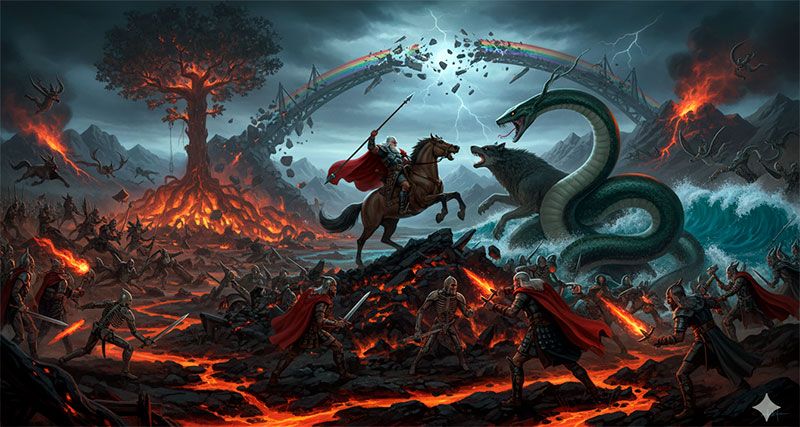
The texts describe a series of signs that foreshadow the collapse. These signs combine natural disasters, social breakdown and the release of supernatural prisoners:
- Fimbulwinter: three consecutive winters with no intervening summers; famine, cold and climatic chaos.
- Extreme human conflict: treachery, violence among kin and the breakdown of law and hospitality.
- Darkening of the sky: the sun and the moon are devoured by cosmic wolves (Sköll and Hati), and the stars disappear.
- Release of prisoners: Loki escapes, Fenrir breaks his chains and Jörmungandr (the world serpent) rises from the sea.
- The ship Naglfar, made from the nails of the dead, sets sail laden with warriors from Hel.
- Alarm call: Heimdall blows the horn Gjallarhorn to summon the gods for the last time.
These signs culminate in tremors throughout Yggdrasil: roots, mountains and the cosmic balance crack.
The final battle and key confrontations
The decisive contest takes place on the plain of Vigrid. There the gods and their warriors face a coalition of giants, monsters and resurrected dead. Although many gods know the outcome by prophecy, the narrative emphasizes bravery and honor in battle—central values of the Norse warrior culture.
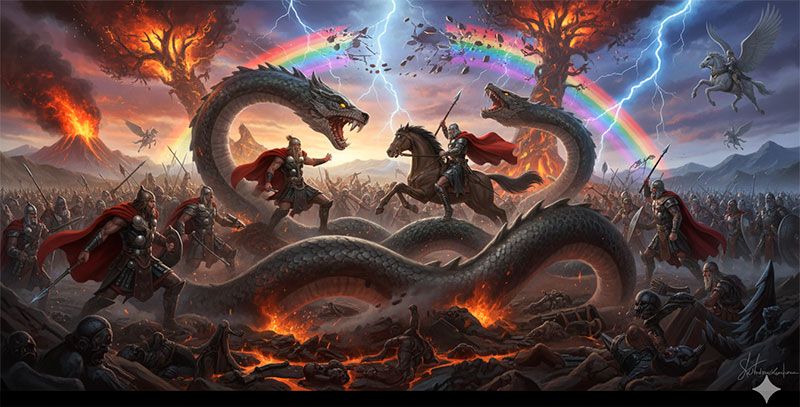
Most emblematic duels and deaths
- Odin vs Fenrir: Odin is devoured by the wolf Fenrir; his son Víðarr avenges him by killing the wolf.
- Thor vs Jörmungandr: Thor manages to kill the world-serpent but walks nine steps and dies poisoned.
- Loki vs Heimdall: they kill each other in direct combat.
- Freyr vs Surt: Freyr falls because he had been left without his magic sword.
- Týr also meets his death during the conflagration.
| God/Hero | Enemy | Outcome |
|---|---|---|
| Odin | Fenrir | Is devoured; Víðarr will avenge him by killing Fenrir. |
| Thor | Jörmungandr | Kills the serpent but dies poisoned after taking nine steps. |
| Loki | Heimdall | They kill each other. |
| Freyr | Surt | Dies for lack of his magic sword against the fire giant. |
| Týr | Fenrir / forces of chaos | Dies in the battle; he had already lost his hand when binding the wolf. |
The end, the fire and the renewal
After the battles, Surt, lord of the fire giants, sets the world ablaze with his sword, consuming the skies, the earth and the seas. Much of the cosmos sinks and Yggdrasil trembles until it nearly breaks. Nevertheless, from the chaos a new order emerges: the earth rises renewed, the sun reappears with a daughter of the sun-goddess, and some young gods (such as Víðarr, Váli, Móði and Magni) together with two surviving humans (Líf and Lífþrasir) repopulate the world.
Cultural significance and legacy
Ragnarök expresses both a tragic and hopeful vision. On the one hand, it portrays an inescapable destiny where even the gods are subject to wyrd (fate); on the other, it affirms cyclical continuity: destruction gives way to renewal. This blend of fatalism and regeneration influenced the Viking ethic regarding bravery and dignity in the face of death.
Historically, some scholars suggest that parts of the account may have been shaded by Christian influence on the thirteenth-century Icelandic chroniclers, although the central idea of a cataclysm followed by rebirth already appears in older sources. In contemporary culture, Ragnarök continues to inspire literature, film, comics and video games, where it is reinterpreted as a metaphor for radical change and hope after catastrophe.
Recommended readings (classic sources)
- Poetic Edda — a collection of mythological poems.
- Prose Edda by Snorri Sturluson — a synthesis and commentary on myths and genealogies.
The myth of Ragnarök condensed for Norse societies a symbolic explanation of the end of the known world and an ethical guide on how to face it: with courage, awareness of fate and the idea that from destruction a new beginning can emerge.