
Shopping Cart
There are no more items in your cart
What is Valhalla?
Valhalla is, in Norse mythology, much more than a mere hall: it is the glorious destination reserved for warriors who die with honor in battle. Associated with Odin and located in Asgard, this space combines the idea of a reward after death with the practical function of preparing those warriors for the final battle of the cosmos.
Origin and meaning of the term
The name comes from Old Norse Valhöll, which literally translates as "hall of the slain". In the Viking mindset it represented the reward for bravery and sacrifice; entering Valhalla was the highest distinction for those seeking eternal fame.
Sources and variations
Descriptions come primarily from the Eddas (Poetic and Prose) and the sagas. These sources do not always agree on every detail, so some features of Valhalla vary depending on the tradition or the author recounting them.
Location and architectural features
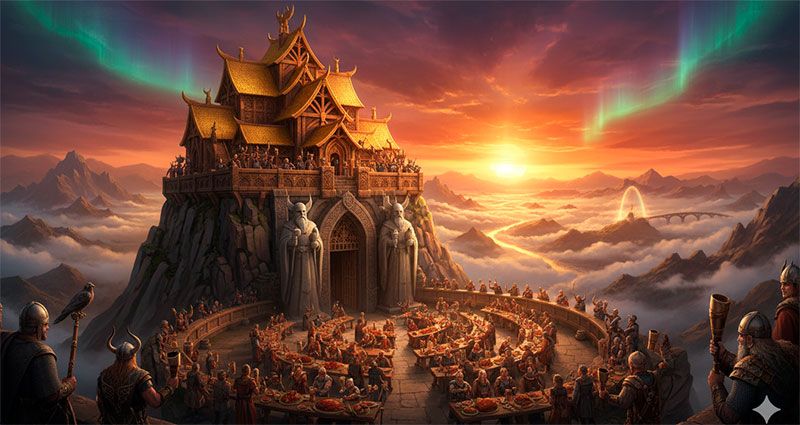
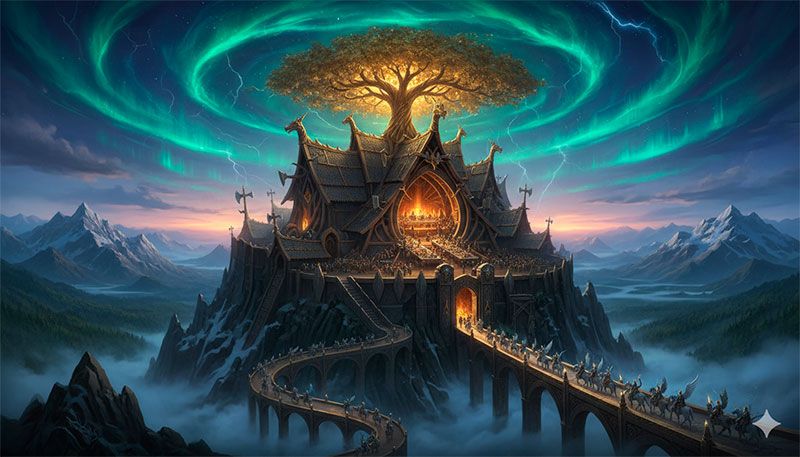
Valhalla is located in Glaðsheimr, a part of Asgard associated with the gathering of heroes and great assemblies. In the sources it is described as an immense and resplendent hall with features that emphasize its extraordinary nature:
- Numerous doors: it is said there are 540 doors, each wide enough for eight warriors to pass abreast.
- Visual splendor: a golden glow that makes it visible from afar, a symbol of its magnificence.
- Communal space: designed for large feasts and to accommodate thousands of warriors.
Who inhabits Valhalla: the Einherjar
The inhabitants of the hall are the Einherjar, warriors chosen after dying in battle. Not all the dead arrived there: tradition holds that roughly half of those fallen in combat were taken by the valkyries to Valhalla, while the other half could be destined for Fólkvangr, the domain of the goddess Freyja.
- Selection: carried out by the valkyries, who identified the bravest and most honorable.
- Name: "Einherjar" can be translated as "those who fight alone" or "the fallen warriors".
The role of the valkyries
The valkyries are divine female figures tasked with choosing the dead fit for Valhalla. They act as messengers of Odin and often appear in tales with complex traits: warriors, weavers of fate, and sometimes lovers of mortals or heroes. Some famous valkyries in the sagas are Brynhildr, Sigrún and Göndul.
Routine and customs inside Valhalla
Life in Valhalla combines training and celebration. It is not a static paradise, but a place where warriors actively prepare for the final cosmic struggle:
- Daytime training: ritual combats and military practices that keep the Einherjar in shape and hone their skills.
- Nightly feasts: large banquets with meat and mead, music and stories recited by skalds.
- Camaraderie: fraternal bonds among the warriors and the symbolic presence of Odin, accompanied by his wolves Geri and Freki.
Ultimate purpose: preparation for Ragnarök
Valhalla serves a clear function: to gather and train the best warriors for Ragnarök, the final battle that, according to Norse mythology, will pit gods against the forces of chaos. In that cosmic conflict, the Einherjar would fight alongside Odin and other gods with the hope of upholding order or dying gloriously.
Cultural values it represents
Besides its religious and esoteric component, Valhalla embodies social values deeply rooted in Norse communities:
- Bravery and courage as supreme virtues.
- Honor and reward for dying in combat.
- Warrior community: the idea of belonging to an elite that shares fate and memory.
Valhalla's legacy today
In contemporary culture, Valhalla has transcended the ancient sources and appears in literature, film, video games and music as a powerful symbol. At the same time, its modern use sometimes simplifies or distorts historical and mythological details. The original accounts emphasize both the epic dimension and the moral complexity: honor in battle, the inevitability of fate and ambivalence toward death.
Final notes on interpretation
When approaching Valhalla, it is worth remembering that the images and descriptions come from accounts written centuries after Viking practices, and that oral traditions could vary regionally. Therefore, more than a single fixed place, Valhalla functions as a multifaceted symbol that combines reward, preparation and collective memory.