
Shopping Cart
There are no more items in your cart
What is the Futhark?
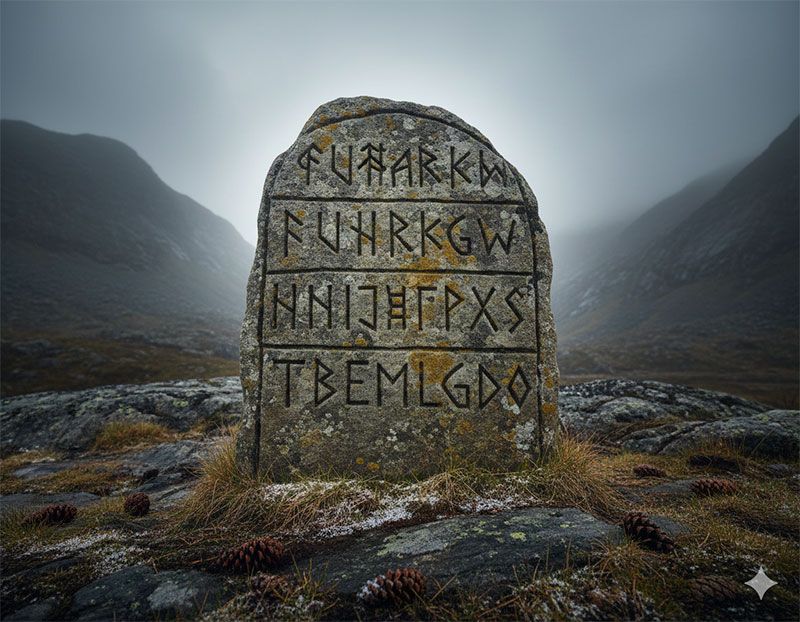
The Futhark is the traditional name given to the oldest Germanic runic alphabet, used by Germanic and Scandinavian communities to write early forms of Norse (Proto-Norse and Proto-Germanic) between approximately the 3rd and 8th centuries AD. Its name derives from the sequence of its first six letters: F, U, Þ (Th), A, R and K, which together form the word "Futhark". These runes were not only phonetic signs: each one had its own name and a symbolic meaning tied to the cosmology and daily life of the societies that used them.
Main characteristics of the Elder Futhark
The so-called Elder Futhark is composed of 24 runes, organized into three groups of eight characters known as aett (plural: aettir). This grouping is not arbitrary: each rune has a sound value, a conventional name and, frequently, a symbolic or ritual interpretation.
- Organization: 3 aettir of 8 runes each.
- Function: writing, marking objects, funerary inscriptions, and ritual/magical use.
- Form: straight strokes designed to be carved in wood, bone and stone.
Distribution of the runes (Elder Futhark)
- First aett: fehu (f), ūruz (u), þurisaz (th), ansuz (a), raidō (r), kauną (k), gebō (g), wunjō (w).
- Second aett: haglaz (h), naudiz (n), īsą (i), jērą (j/y), īwaz (ï/æ), perþō (p), algiz (z), sōwulō (s).
- Third aett: tīwaz (t), berkō (b), ehwaz (e), mannaz (m), laguz (l), ingwaz (ng), dagaz (d), ōþalą (o).
Uses: from the everyday to the sacred
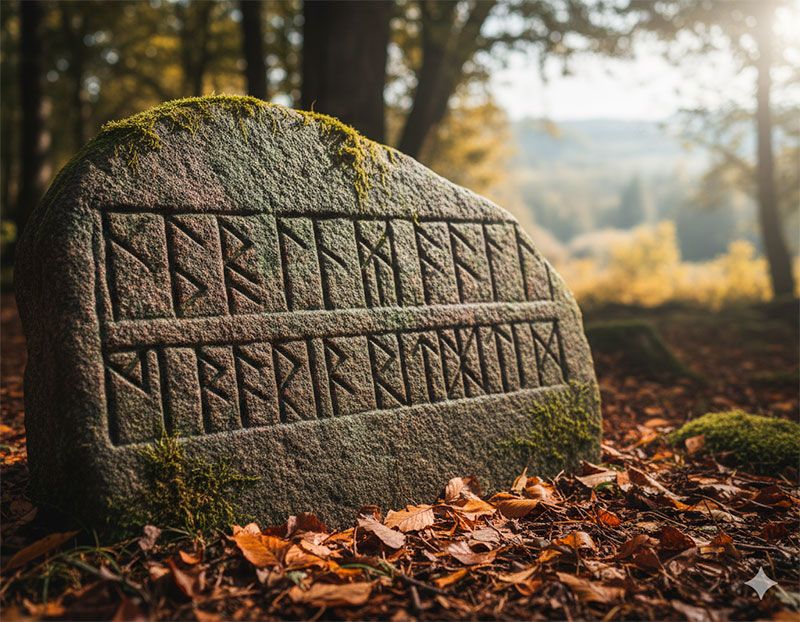
Runes appeared on a wide variety of media: runestones (commemorative monuments), jewellery and amulets, tools and weapons, coins and bracteates. Beyond practical inscription (names, dedications, ownership marks), in the Norse tradition runes had a ritual and magical dimension.
- Ritual and magic: mythological texts attribute the discovery of the runes to Odin; from there they are associated with divinatory powers, protection and sorcery.
- Carving technique: straight strokes predominate because they are adapted to engraving on hard materials.
- Composite forms: there are "bindrunes" (combinations of runes) used to abbreviate or amplify meanings.
Evolution and regional variants
The Futhark did not remain static. Depending on region and time it underwent significant transformations:
- Younger Futhark: emerged and spread in Scandinavia during the Viking Age; it reduced the 24 runes to 16, simplifying the system in response to phonological changes.
- Futhorc (Anglo-Frisian): a variant that adds runes up to 29 and sometimes 33 signs, to reflect sounds of Old English that were not present in the Elder Futhark.
- Persistence: in some areas runes continued to be used for local inscriptions until the late modern period.
Archaeological evidence includes objects such as the Kylver stone (Gotland, c. 400 AD), which preserves one of the earliest known complete sequences. Over time much knowledge about reading runes was lost until its reconstruction in the 19th–20th centuries by philologists and archaeologists.
Decipherment and modern use
Linguistic and epigraphic analysis made it possible, from the 19th century onward, to systematically interpret runic inscriptions. Researchers such as Sophus Bugge made key contributions to the study of the runic system. Today, runes are part of academic studies in linguistics, history and archaeology; they have also been incorporated into the Unicode standard (Runic block, U+16A0–U+16FF), which facilitates their typographic reproduction on digital devices.
How to approach the runes if you want to study them
- Learn the transliteration: runes are today represented with standardized Latin letters to facilitate their reading.
- Consult archaeological sources: images and records of inscriptions help to understand graphic variants.
- Take context into account: many inscriptions are brief and locally meaningful (names or ritual formulas), so interpretation requires care.
| Variant | Main region | Approximate period | Number of runes | Notes |
|---|---|---|---|---|
| Elder Futhark | Northern and central Europe | c. 200–800 AD | 24 | Origin of the classical runic alphabet. |
| Younger Futhark | Scandinavia | c. 800–1300 AD | 16 | Viking version, fewer signs due to phonetic changes. |
| Futhorc (Anglo-Saxon) | British Isles | c. 5th–11th centuries AD | 29–33 | Adaptation for sounds of Old English. |