
Shopping Cart
There are no more items in your cart



What is Rockwell hardness?
Rockwell hardness is a practical, standardized measure that assesses a material's resistance to surface penetration. It is widely used in the metallurgical industry and in quality control, and is especially relevant when selecting steels for cutlery and bladed weapons, where the balance between edge and toughness is crucial.
What is Rockwell hardness and how is it interpreted?
The Rockwell test determines hardness by measuring the depth of an indentation left by an indenter under a controlled load. Unlike methods that measure the diameter or diagonal of the mark (Brinell or Vickers), Rockwell provides a direct, fast value expressed as a number accompanied by a scale (for example, 60 HRC).
Basic steps of the test
- Preparation: the specimen must be flat and sufficiently thick; the surface clean and, generally, polished.
- Preload (or minor load): a small load is applied (normally 10 kg or 3 kg in the superficial variant) to seat the indenter and eliminate elastic deformation effects.
- Major load: an additional load is applied for a set time (seconds), which can range from 15 to 150 kg depending on the scale used.
- Measurement: after removing the major load and keeping the preload, the remaining depth is measured. Rockwell hardness is calculated as HR = E − e, where E is a reference and e is the actual penetration.
An important point: the higher the Rockwell number, the harder the material, since it indicates less penetration depth under the applied load.
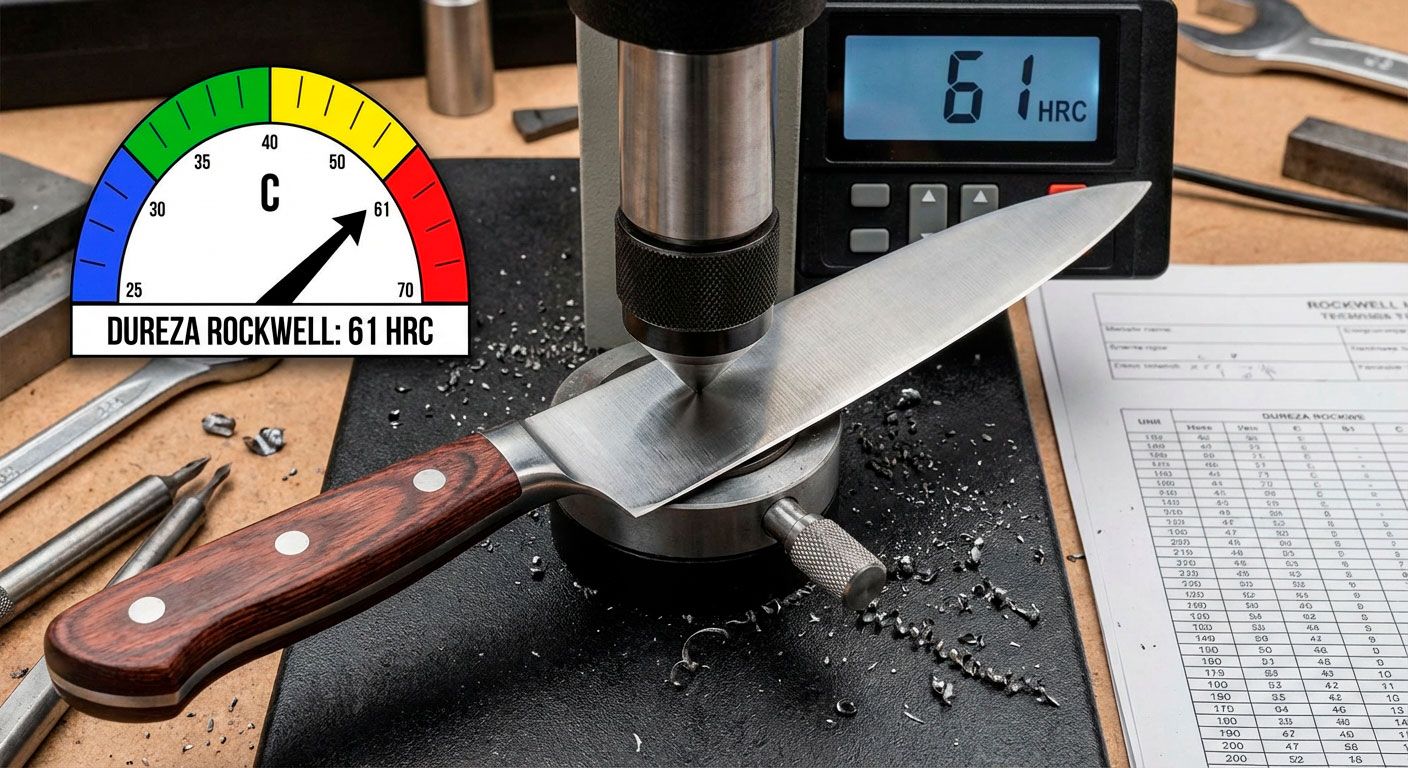
Types of indenters and most used scales
There are about 30 Rockwell scales. The combination of indenter (diamond cone or ball) and loads defines each scale. The most relevant for steels and cutlery are:
- HRC: uses a diamond cone and a 150 kg major load; intended for hardened steels and tools.
- HRB: uses a 1/16" ball and a 100 kg major load; suitable for less hard metals such as bronze or hard aluminum.
- HRA: diamond cone with a lower major load than C; for very hard materials and surface treatments.
- Rockwell Superficial (15N, 30N, 45N, 30T…): uses smaller preloads and major loads (3 kg) to measure surface layers without penetrating through them.
Table: common scales and uses
| Scale | Preload (kg) | Major load (kg) | Indenter | Typical use |
|---|---|---|---|---|
| HRC | 10 | 150 | Diamond cone | Hardened steels (knives, tools) |
| HRB | 10 | 100 | 1/16" ball | Moderately hard metals (aluminum, brass) |
| HRA | 10 | 60 | Diamond cone | Very hard materials, case-hardened layers |
| 15N / 30N / 45N (superficial) | 3 | 15 / 30 / 45 | Diamond cone | Surface layers (carburization) |
| 30T (superficial) | 3 | 30 | 1/16" ball | Thin surfaces |
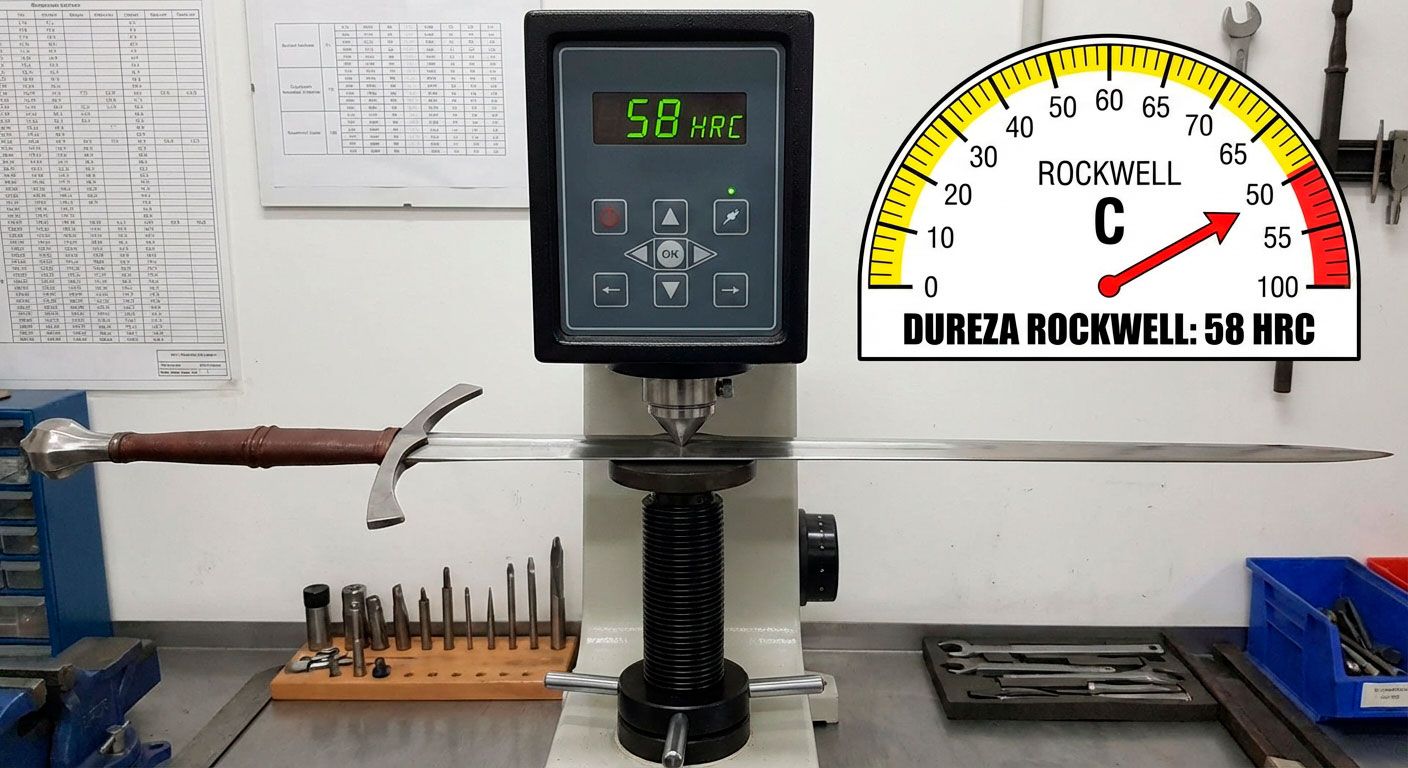
Practical importance in bladed weapons
In cutlery and bladed weapons hardness influences two fundamental properties:
- Edge retention: harder materials keep the edge longer.
- Toughness: softer materials better withstand impacts and bending without chipping.
Typical ranges and their effects:
- ≈ 55–58 HRC: good compromise between edge and toughness; easy to sharpen.
- ≈ 58–64 HRC: greater edge retention; at the upper end toughness may decrease.
- > 64 HRC: very durable edge but higher risk of fracture or chipping if the proper microstructure is not achieved.
Advantages and limitations of the Rockwell method
- Advantages: fast, reproducible, suitable for production and quality control; direct reading.
- Limitations: sensitive to surface finish and material homogeneity; not suitable for very thin parts or complex geometries; extremes of the scale require switching to another scale to avoid damaging the equipment.
Simplified comparison with other methods
| Method | What it measures | Best for |
|---|---|---|
| Rockwell | Depth of indentation | Steels and rapid production |
| Brinell | Indentation diameter | Soft metals and large parts |
| Vickers | Indentation diagonal | Thin layers and the full hardness range |
Practical tips for cutlery
- Choose according to use: general-purpose knives: 55–58 HRC; high-performance: 58–62 HRC.
- Maintenance: very hard steels (>62 HRC) require appropriate stones or sharpeners; hand sharpening demands skill.
- Quality control: in manufacturing, verifying HRC after heat treatments ensures consistency.
- Conversion: equivalencies with Brinell or Vickers are approximate; use official tables for precision.
Standards
Tests follow recognized standards such as ISO 6508 and ASTM E18, which define procedures, conditions, and tolerances to obtain comparable results.
Understanding Rockwell hardness allows selecting the appropriate steel and heat treatment to achieve the balance between edge retention and toughness needed for each type of blade or cutting tool.