
Shopping Cart
There are no more items in your cart


What is a Heraldic Shield?
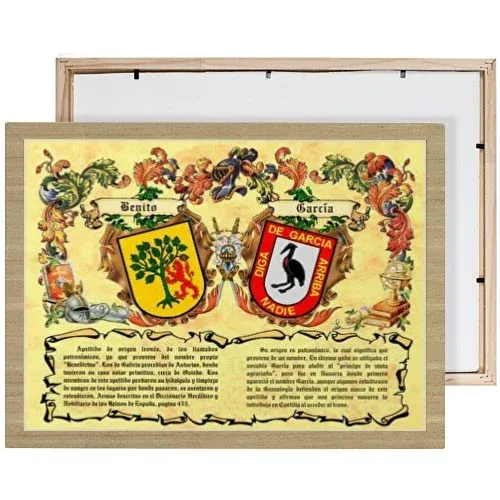
A heraldic shield —also called a coat of arms— is a visual emblem that identifies a family, lineage, city, or institution. Born in the Middle Ages as a practical tool to recognize combatants wearing armor, it evolved into a symbolic language with its own rules that still serve today to tell family, social, and territorial stories.
Origin and historical importance
Heraldry emerged in Europe during the 11th–12th centuries. In tournaments and battles, armor concealed the face, so knights used symbols painted on shields and banners to identify themselves. Over time those signs ceased to be mere identifiers and became hereditary emblems that conveyed lineage, property, honors, and political or marital ties.
Why do they endure?
- They represent family continuity and historical memory.
- They function as a visual language with rules to avoid ambiguities.
- They are used by institutions, municipalities, and in cultural contexts as symbols of identity.
Fundamental components of a heraldic shield
Although shape and ornamentation can vary, every heraldic shield is composed of basic elements that follow rules of legibility and symbolism:
- Field: the background of the shield, made up of tinctures (colors and metals).
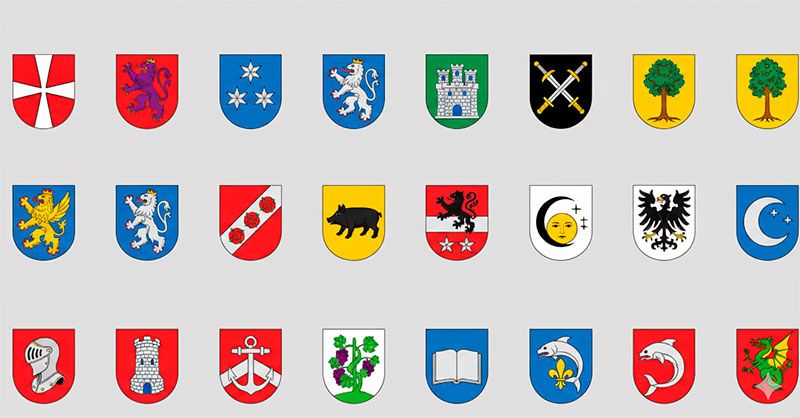
- Charges: the figures that occupy the field (animals, plants, objects, geometric shapes).
- Divisions: partitions of the shield that allow combining different arms (quarters, fess, bend, crosses).
- External ornaments: helmet, crest, mantling, and supporters that frame and distinguish the blazon.
Tinctures: color, metal, and meaning
Tinctures are conventionally limited to ensure contrast. A basic rule: no metal on metal nor color on color. In traditional blazon there is a distinction between metals (Or, Argent) and colors (Azure, Gules, Vert, Sable, Purpure).
| Tincture | Color | Common meaning |
|---|---|---|
| Gules | Red | Courage, strength, boldness |
| Azure | Blue | Loyalty, justice, prudence |
| Vert | Green | Hope, fidelity, abundance |
| Sable | Black | Discretion, constancy, dignity |
| Purpure | Purple | Sovereignty, nobility, rarity |
| Or | Yellow/Gold | Generosity, elevation |
| Argent | White/Silver | Purity, faith, sincerity |
Charges and ordinaries
The charges (lions, eagles, towers, crosses, fleur-de-lis, etc.) interpret deeds, professions, or virtues. The ordinaries —such as the fess, bend, chief, cross, or bordure— serve to highlight an area of the shield or to combine inheritances by quartering.
- Chief: the upper third; indicates dignity or office.
- Fess: central horizontal band; can represent alliance or mandate.
- Bend: diagonal band that often symbolizes defense or participation in battle.
- Bordure: border that sometimes indicates a protective bastion or a cadet branch of the family.

How to read a shield: basic notions of blazon
The blazon is the verbal description of the shield, and it follows an established order: first the tincture of the field, then divisions and ordinaries, then the charges and their positions, and finally the crests and supporters. Simple example: "Azure, a lion rampant Or in the center".
- The dexter of the shield is the right of the bearer (left of the observer) and is often considered the principal side in some readings.
- Repetitions of charges should be uniform in shape, color, and size unless otherwise specified.
Contemporary uses and cultural value
Today heraldic shields are seen on public buildings, seals, universities, municipal flags, and as symbolic representations of families and groups. Beyond decoration, they act as visual archives that condense genealogy, alliances, and historical events into a compact design.
Quick tips for someone discovering their coat of arms
- Learning to read the blazon helps interpret colors and figures.
- Consulting local historical archives can confirm variants and family lines.
- Respecting heraldic rules (tinctures/metals, proportions) preserves the authenticity of the emblem.
Interpreting a shield is reading a story in images: each tincture, each figure, and each division was chosen to communicate something specific about its bearer.