
Shopping Cart
There are no more items in your cart
What is a Stola?
The stola was the emblematic garment of the matronae (matrons) in Ancient Rome: a long outer tunic that, besides covering, signaled marital status, social position and moral values such as modesty and conjugal fidelity. At a glance it distinguished the married woman from others, analogous to the male toga.
Origin and historical meaning
The stola developed in the context of a society where clothing functioned as a social language. Its use was especially linked to marriage: receiving or wearing it was a sign that the woman belonged to a legitimate and respectable family. Its influence can be traced to Greek garments like the chiton, although the stola acquired its own shapes and uses in Rome.
In Latin literature and art the stola appears associated with conjugal virtue; in extreme cases, its removal or the obligation to wear the toga could be used as a symbolic punishment (for example, against women accused of adultery in certain periods), opposing the toga to the stola as a sign of disgrace.
Design and construction
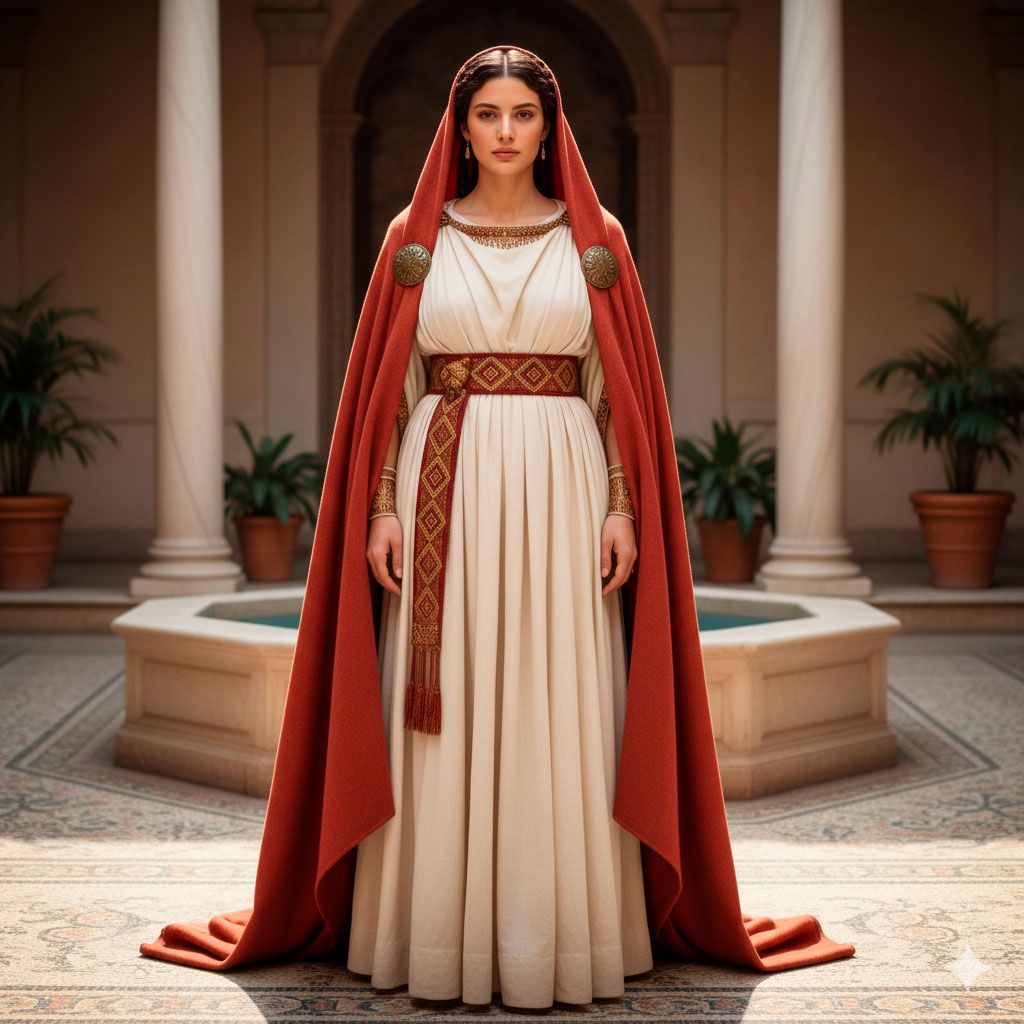
Physically, the stola was a long garment reaching the ankles and, in its classic form, was cut from rectangular or square pieces of fabric. Its main features were:
- Shape: rectangular piece or two panels joined with an opening for the head.
- Fastening: secured at the shoulders with fibulae, brooches or seams.
- Waists and girdles: worn belted under the bust (empire style) or at the waist with belts such as the zona, the succinte or the patagium.
- Lower edge: the instita, a decorative hem or band that concealed the feet out of modesty and served as a distinguishing element.
- Sleeves: could have long or short sleeves or be held with straps, offering variation according to fashion and climate.
Materials and color
The choice of fabric and dye was a direct way to display status:
- Wool was common and practical.
- Linen and lightweight cottons were used in warm climates or in finer versions.
- Silks, imported and sometimes decorated with gold thread or pearls, indicated wealth.
- Natural dyes allowed everything from sober tones to bright colors; colorful bands or clavi on the edge were common on elite garments.

How it was combined: garments and accessories
The stola was not worn alone. It formed part of an ensemble:
- Subucula or inner tunic: garment worn next to the skin, in linen or fine silk.
- Palla: rectangular cloak worn over it as a shawl or veil, covering shoulders and head depending on the occasion.
- Accessories: jewelry (pearls, necklaces), ornamental belts, and practical items such as fans or parasols among the elite.
Social distinctions and variants
The stola had variations according to era and status:
- Local and temporal forms: in early Rome it tended to be more austere; in the High Empire, with eastern contacts, richer and more decorated versions emerged.
- Hierarchies: certain details —embroidery, colored bands, silk— clearly marked social position.
- Continuity: in the Byzantine Empire the idea of a ceremonial female tunic continued in official and ecclesiastical contexts with formal evolutions.
The stola today: study and recreation
Today the stola is known through archaeological sources (statuary, frescoes, mosaics) and texts. It also appears in historical reenactments, theatrical productions and living history activities (recreations, LARP, museums), where cuts, fastenings with fibulae and draping are reproduced based on finds. These reconstructions help to understand not only the silhouette but also the social function of the garment.
| Common materials | Characteristics | Examples of use |
|---|---|---|
| Wool | Traditional, warm, durable; common in the daily life of middle and rural classes. | Sober, functional garments for everyday use. |
| Linen / Cotton | Light and cool; suitable for warm climates and for undergarments. | More comfortable and cooler models, common in summers and coastal cities. |
| Silk | Imported, luxurious; combined with embroidery, gold and pearls to denote prestige. | Used in ceremonies, public representation and portraits of the elite. |
Keys to understanding the stola
- It was not just fashion: it was a visible social code.
- Its shape and decoration conveyed messages about marriage, class and virtue.
- Current research combines texts, iconography and textile finds to reconstruct its variants.
The stola, therefore, offers a window into how female identity functioned in Rome: a garment full of meaning that articulated social expectations and marked the public presence of the matrona.